At each biennial National Convention, the League of Women Voters of the United States (LWVUS) adopts an education and advocacy platform, or program, that will guide League actions over the next two years. At the June 2026 convention, the LWVUS passed a significant resolution that seeks to change how the country selects its President. By an overwhelming vote of 886-22, it adopted the
National Popular Vote Interstate Compact (the “Compact”) as part of its National Program. The Compact provides an alternative to the current “winner takes all” method of awarding all electoral votes for a state to the candidate who won that state’s presidential election. Instead, it would ensure that the election of the President of the United States is based on the overall national popular vote.
Arguments for the Compact. Those supporting passage of this resolution cited the unfairness of the current system. They pointed to the 2016 election in which Hillary Clinton received 65,853,514 votes to Donald Trump’s 62,984,828 but received only 227 electoral votes to Trump’s 304. They also noted the contested presidential election in 2000, where George W. Bush was ultimately elected President only because he won Florida by a mere 537 popular votes. Supporters further believe that basing the presidential election on the popular vote would require candidates to pay attention to voters in all states, not just those in closely divided battleground states. This would avoid situations as in 2024 where an overwhelming number (94%) of campaign events leading up to the general election took place in just seven states, relegating 43 states and 80% of US voters to mere bystanders.
Is it consitutional? People who support the Compact claim that, unlike elimination of the Electoral College, enacting the Compact does not require a Constitutional amendment. They base this on the wording of Article II of the Constitution, which grants states exclusive control over the method by which they award their Electoral College votes. Thus, supporters contend, a state can decide to award all its votes to the presidential candidate who wins the most votes
across all 50 states and the District of Columbia. That is, a state’s Electoral College members would look at nationwide vote counts–and then cast their Electoral College votes for the candidate who received the most votes nationwide.
How would it work? To achieve the desired outcome, it is not necessary for every state to join the Compact, just enough to ensure that a majority of the Electoral College votes go to the candidate who wins the popular vote. The Compact has already been enacted into law by 18 states, including Illinois, plus the District of Columbia; 5 small states (DE, HI, ME, RI, VT); 10 medium-sized states (CO, CT, MD, MA, MN, NJ, NM, OR, VA, WA); and 3 large states (CA, IL, NY) have agreed to use this more democratic method of electing the President, contingent on the Compact’s adoption by enough states to guarantee a win by the highest vote-getter. These states plus DC together hold 222 of the 270 electoral votes needed to become president, so only 48 more electoral votes are required to ensure that our country’s President is selected by the most democratic of processes, the popular vote.
Current Status of the Compact by State
This map was last updated in July 2026. States shaded in yellow had enacted National Popular Vote Interstate Compact legislation.
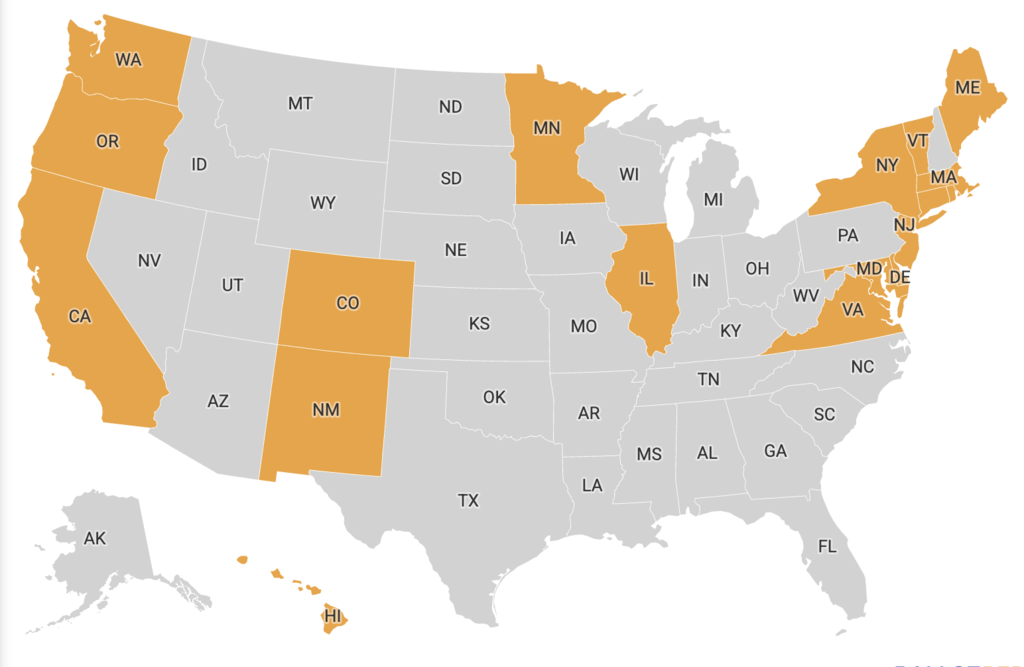
Map: Ballotpedia, Source: National Popular Vote
Reasons for opposition. Not everyone supports the Compact, however. Where proponents see no constitutional barrier, others firmly believe that the existing scheme, which relies on electors, is the only one considered by the Founding Fathers. This, they contend, means that the drafters of the Constitution rejected the idea of electing the President by direct, popular vote. Critics also argue that taking account of how other states vote should not be, and has never been, a consideration for state electors. They point out that since the Constitution was drafted and ratified, no state has ever asked its presidential electors to consider and act in accordance with the popular vote of any other state. Finally, they argue that the current Supreme Court would not likely find the Compact constitutional and would hold that only an amendment to the Constitution can make such a significant change in the method of selecting our President.
A grass roots effort. Significantly, consideration and approval of the Compact as part of the LWVUS National Program was a grass roots effort, not one initiated at the national level. It will be interesting to see what, if any, actions LWVUS, as well as state and local Leagues, take to promote expanded adoption of the Compact.